

A Princeton Neuroscience Professor Is Running For Congress
Professor Samuel S. Wang, a longtime election reform advocate, is among the Democratic primary candidates for New Jersey’s 12th District
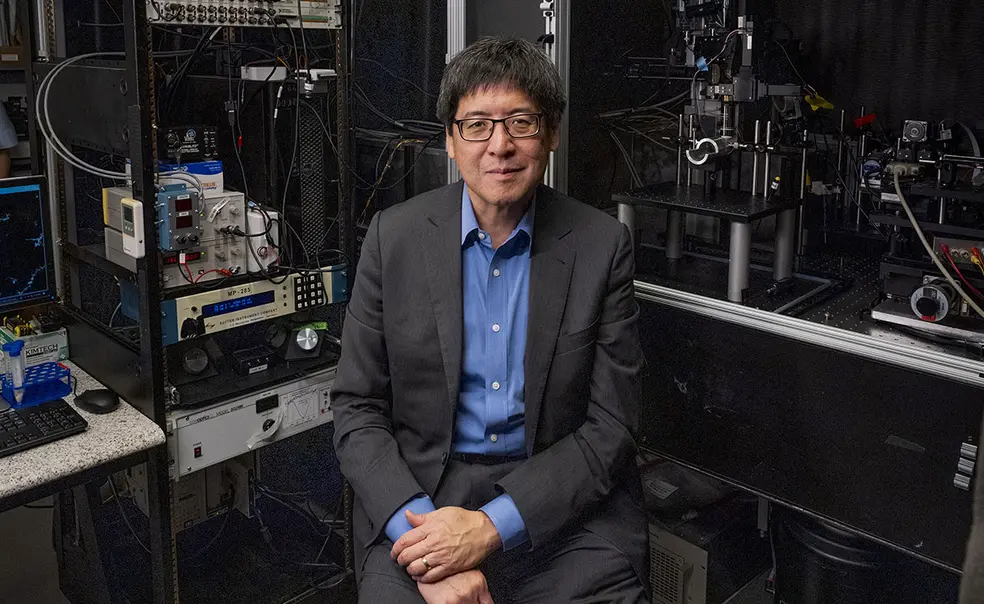

Princeton neuroscience professor Samuel S. Wang is running for Congress as a Democratic candidate in New Jersey’s 12th District, which includes the municipality of Princeton. He is one of 16 Democrats vying for the seat held by Bonnie Watson Coleman, who announced she will retire after the current term, her sixth in the House of Representatives.
“This is a very challenging time for our system of government and life,” Wang told PAW. “I think it is time for everyone to do what they can to save the system.” He filed with the Federal Election Commission on Jan. 26.
Aside from his background in neuroscience, Wang has extensive experience in the political and electoral sector, where he has used data science to advocate for equitable redistricting and election reform for over two decades. In 2014, he founded the Gerrymandering Project, using statistical analysis for equitable redistricting reform, and in 2020, he founded the Electoral Innovation Lab, also using mathematical methods to propose electoral reforms.
On the 2021 New Jersey Congressional Redistricting Commission, Wang served as the technical consultant to commissioner John Wallace, who held the tie-breaking vote in drawing the congressional map. However, Wang specified that “it was true that I was assisting, but I did not draw a single line. … I was an analyst and just did the job I was given, which was to evaluate fairness.”
Wang’s motivation to run for office stems primarily from current issues in the congressional system. “Right now,” he said, “Congress is having a lot of trouble asserting itself. It’s supposed to be setting the laws and determining spending, but we have things like illegal spending … impoundment, threatening the independence of higher education and limiting research funding to eliminating public agencies all done to varying degrees illegally.” Wang also highlighted gerrymandering as a key issue he aims to eliminate by sponsoring a law that would implement independent citizen commissions for redistricting.
Wang said he believes that his extensive electoral experience positions him best to address these issues alongside other members of Congress. “I am a mathematical biologist, and I study not only neuroscience, but also elections and voting systems,” he said. “I’m hoping that that expertise will be useful to serve other members of Congress in finding ways to make the [electoral] systems work better.”
The University can grant temporary leave for professors filling government posts, according to the dean of the faculty’s website. Wang declined to specify what he planned to do about his faculty post if elected.
Wang aims to focus his campaign on rebuilding government structures and policies worn down by the current administration and creating new laws that reassert the will of voters and citizens. “If we can survive the current time,” he said, “it is a chance to not only make repairs but to build something new, and I hope to be part of that.”
The Latest
See all


Related News

Bengals Receiver Andrei Iosivas ’23 Is Building a Solid NFL Career
‘Being a late-round draft pick coming from a small school, you want to always prove something,’ Iosivas says

1 Response
Cathianne Leonardi
4 Months AgoData Science Across Disciplines
Great article. It’s fascinating how development of data, when done well, can inform many disciplines.